
Grant County Criminal Docket Searches
Felonies and most other criminal matters sit in Grant County Circuit Court. The free public starting point is Search ARCourts. Pick the case search mode, set County Name to GRANT and Court Name to GRANT CIRCUIT, then enter a party name or a criminal case number. Grant Circuit criminal numbers follow the 27CR-YY-N pattern. A full number is best. It pins down the county code, the criminal case type, the filing year, and the sequence all at once.
Misdemeanors and preliminary matters may belong to Grant County State District Court instead. That court does not appear among the portal's Grant district choices. So contact the District Court Clerk by phone, at the counter, or by mail. A blank Circuit Court search never proves that no criminal docket exists.
- Confirm whether the matter is Circuit Court or State District Court from the notice, citation, or case number.
- For Circuit Court, search GRANT CIRCUIT by a full 27CR number or a known party name.
- Open the candidate case and verify the court, filing date, case type, status, and participant roles.
- Compare Case Events with later Docket Entries for an order, continuance, or reset.
- Ask the correct clerk for an official or certified order when the portal view is not enough.
Grant County Criminal Docket Portal
Each Circuit Court result splits into several views. They are Case Summary, Case Participants, Case Events, and Docket Entries. The summary gives the court, case type, filing date, trial type, and status. Events are scheduled settings. Docket Entries list the filings and court actions in time order. Read the two views together. An event can linger in the history even after a later order moves it. The docket entries tell you what the court actually did.
The official Grant criminal interface shows the column and event layout used for this field inventory.
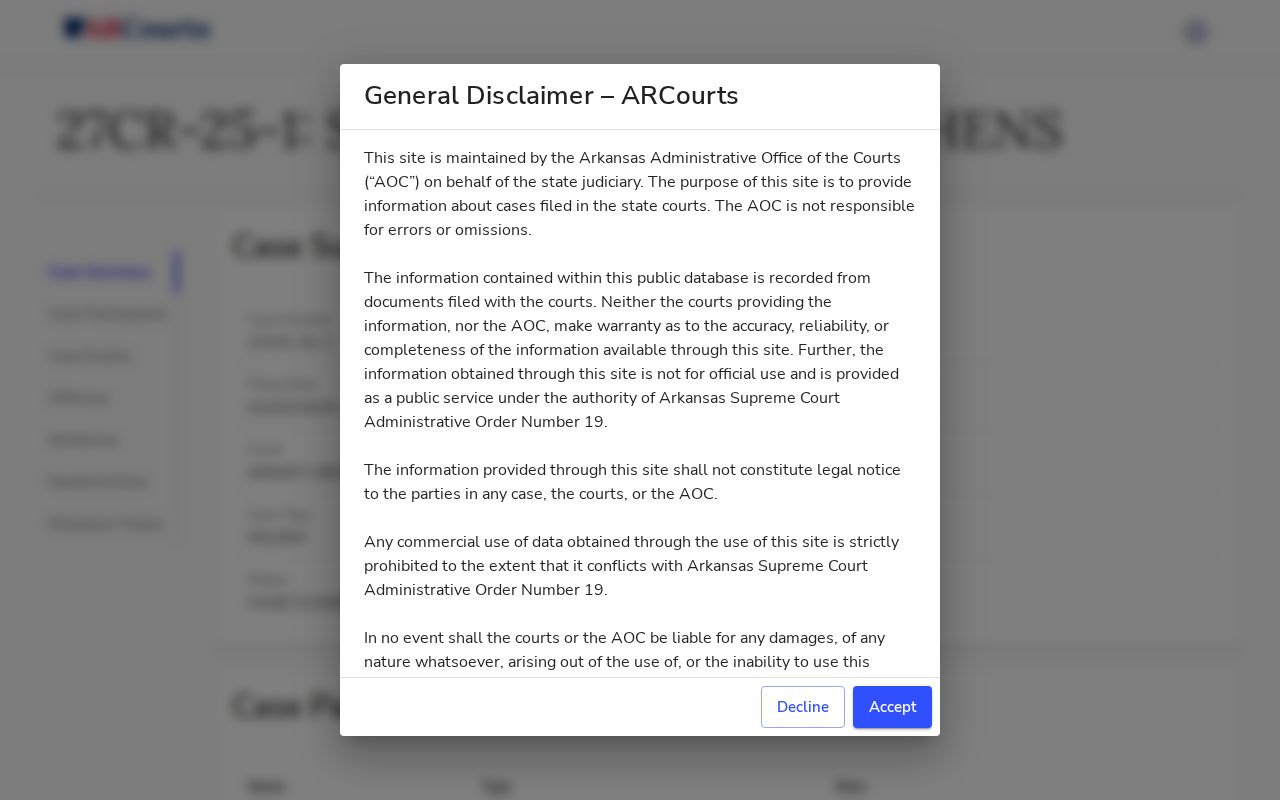
The layout points to one habit worth building: check the case header first, then work through events and entries in date order instead of building a conclusion on a single line.
Criminal Dockets: What They Show
A Grant County criminal docket is an index. It tracks what the clerk received and what the court did. One case can show a Criminal Information, notices, bond or detention entries, counsel appearances, discovery motions, hearing settings, subpoenas, continuances, plea papers, sentencing orders, probation terms, financial entries, and an administrative closure. Some rows carry a WEB link to a public document. Many do not. An index-only row still means the filing exists. The missing link just means you cannot open it there.
| Case Number | A Grant Circuit criminal identifier such as 27CR-25-1, combining county code, case type, year, and sequence. |
|---|---|
| Participants | The judge, the State of Arkansas, the defendant, prosecutors, and defense counsel, each labeled by role. |
| Case Events | Settings with type, date, time, room, location, and assigned judge. |
| Docket Entries | The chronological register of filings, service, motions, orders, disposition, and later financial activity. |
| Documents | WEB links for some public images or PDFs; many rows have no linked image. |
| Status | An administrative state such as CASE CLOSED, which must be read with the disposition and later entries. |
Treat the fields as one record. The case number fixes the court context, the events show planned dates, and the entries document what followed.
Grant County Criminal Docket Entry Context
Context decides what an entry means. A Criminal Information is the formal charge, not a finding of guilt. A warrant issued and a warrant served are separate events. A plea agreement proposes a resolution. The sentencing order records the court's final outcome and its conditions. For an official result, ask the Grant County & Circuit Clerk for a certified sentencing order. Do not rely on a status label or a portal printout.
- PLEA & ARRAIGNMENT
- An early setting for advisement and plea.
- CALL BACK
- A return setting that keeps the matter on the court calendar.
- OMNIBUS HEARING
- A pretrial setting where several issues may be addressed together.
- Continuance
- A request or order that moves a setting; the motion alone does not prove the date changed.
- Sentencing order
- The filed order stating the criminal disposition and sentence.
Financial rows in a Grant County criminal case can list court costs, a fine, booking or administration fees, drug assessments, public-defender fees, restitution, and payments. The ledger tracks activity. It still does not replace the signed order that created each obligation.
Criminal Case Stages on the Docket
Every case runs its own course. A Grant County Circuit criminal docket often traces a path from charging document to final order. Early rows may include probable-cause material and a Criminal Information. An arrest warrant, bond or detention terms, and the first appearance may follow. Counsel appearances and discovery filings tend to come next. Later calendar settings might show plea and arraignment, call back, omnibus hearing, or jury trial. Continuance motions and orders can bend that path at any point.
Docket flow: Filing › Arraignment › Pretrial › Plea or Trial › Disposition › Sentencing
Read through to the latest entry. A plea paper is not the trail's end if a sentencing order follows. CASE CLOSED can also appear before payments or other administrative entries. The docket's time order is the point. It preserves both the planned course and what actually occurred.
Grant County Criminal Docket Forms
Arkansas keeps an official forms library. It helps you recognize common filing names instead of guessing at what they do. One caution applies. A form tells you nothing about the status of a Grant County criminal case. Filing paperwork is a different act from finding the public docket. The case-specific register stays with Search ARCourts or the filing clerk.
The Arkansas Judiciary court-form library is searchable by form type and court use.
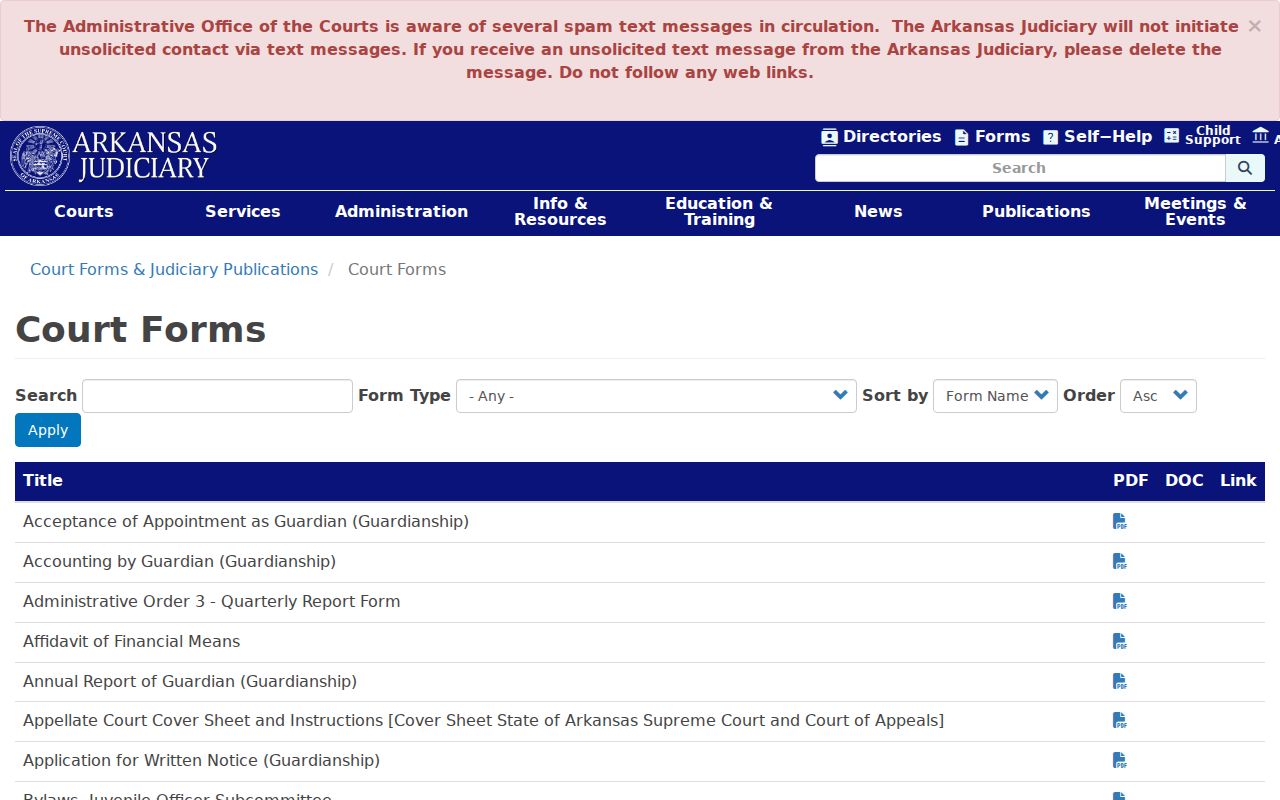
Use that source to decode the official form labels you see in a Grant County criminal docket, not to learn whether a form was filed in a particular case.
Grant County Criminal Docket Courts
Court level decides where a criminal docket lives in Grant County. Felonies and other general criminal matters belong to the Grant County Circuit Court. That court is part of the Seventh Judicial Circuit. The Grant County & Circuit Clerk keeps those files and prepares the Circuit dockets. For participating Circuit records, Search ARCourts serves as the public reference layer.
Misdemeanors, traffic and ordinance violations, and preliminary felony matters sit in Grant County State District Court instead. That court has its own District Court Clerk. The office is at 101 W. Pine Street, Room 5, Sheridan, AR 72150, reachable at 870-942-3464. Don't default to one desk for both record sets. If a case is appealed from district court, it moves up to the Grant County Circuit Court. That transfer follows the applicable rules. Knowing the level first saves a wasted trip and a wrong request.
| Court | Criminal docket | Access path |
|---|---|---|
| Grant County Circuit Court | Felony and general criminal cases | Search ARCourts, then Room 106 clerk contact |
| Grant County State District Court | Misdemeanor, ordinance, traffic, and preliminary felony matters | District clerk phone, counter, or mail |
Grant County Criminal Specialty Docket Limits
Grant County has a real specialty-court history. A historic Seventh Circuit plan documents a Hot Spring and Grant County Drug Court that began in 2005. It also notes a Swift Court that began in 2012. That plan records how the programs started, not who runs them today. It carries no current schedules, staffing, or eligibility rules. The state lists no Grant-specific coordinator or calendar for these programs now. Current Arkansas guidance covers specialty programs statewide. So treat the local details as unconfirmed until a court office answers directly.
For the program types maintained across Arkansas, the Arkansas Judiciary specialty-court overview shows what each program handles.
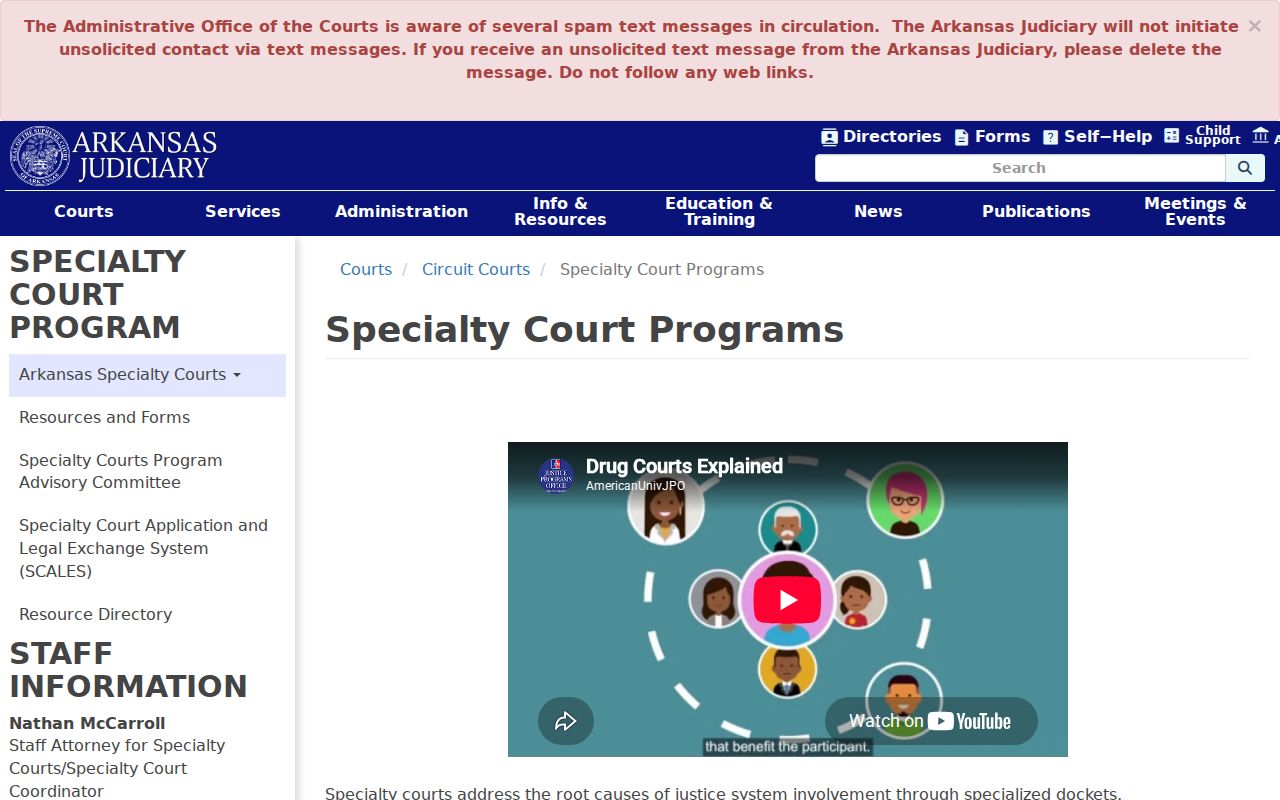
The plain Grant County criminal docket stays the public reference point. Some pieces stay behind closed doors. Treatment assessments, testing results, and team staffing details can remain outside public access, and the restricted SCALES case-management system is not a public docket at all. So a thin public record does not mean nothing is happening in the case.
Access Rules for Criminal Dockets
Administrative Order 19 governs public access to Arkansas court records. Search ARCourts leaves out anything confidential under federal law, Arkansas statute, court rule, or a case-specific order. Social Security numbers, account credentials, sealed information, and internal court material all fall in the protected categories. One nuance matters here. A public docket may show that a restricted document was filed while still withholding the document image itself.
Juvenile matters carry separate statutory protection. Arkansas criminal-record sealing likewise runs through a court process. If a Grant County criminal docket turns up missing, sealing is only one possible reason. The case may simply be old, indexed under another spelling, or held by the nonparticipating district court. Broaden or correct the search. Pin down the court level, and call the proper clerk before drawing any conclusion.
Key access rules:
Administrative Order 19 defines public court-record access and exclusions in Arkansas.
Arkansas Code § 9-27-309 protects juvenile records subject to its stated exceptions.
Arkansas Code §§ 16-90-1401 et seq. govern the process for sealing eligible criminal records.
Grant County Criminal Docket Copy Route
An official copy of a disposition starts with the docket itself. Pull the case number, court, exact document name, and filing date from the Grant County criminal docket first. Then call the Grant County & Circuit Clerk at 870-942-2631 before sending anything. The office sits in Room 106 at 101 W. Pine, Room 106, 101 W. Center, Sheridan, AR 72150. Wait, the address is simply Room 106 at 101 W. Center, Sheridan, AR 72150.
The local fee page lists plain copies at $0.50. Certified copies run $5.00. The page does not state the billing unit or whether both charges stack. Ask the clerk for the total, the payment method, delivery method, and expected retrieval time before you commit.
District misdemeanor files go through the District Court Clerk instead. Grant offices do not advertise copy orders by email, fax, or drop box. So confirm a workable channel before sending money. Older files and entries without WEB links also route back to the filing clerk. For the fuller path from docket entry to filed paper, see the Grant County court case records section on the three record layers.
Note: A free portal view works fine for research. But clerk certification is the authoritative route when an authenticated criminal order is required.